Hurston-1: open-source accented-English TTS built for the phone line (Apache-2.0)
Published October 26, 2026 · Built from the official Hurston-1 model card on Hugging Face, read in full on October 26, 2026. Every evaluation number below is Destined AI's own published evaluation, not independently reproduced - we say so each time it matters. We did not run the model.
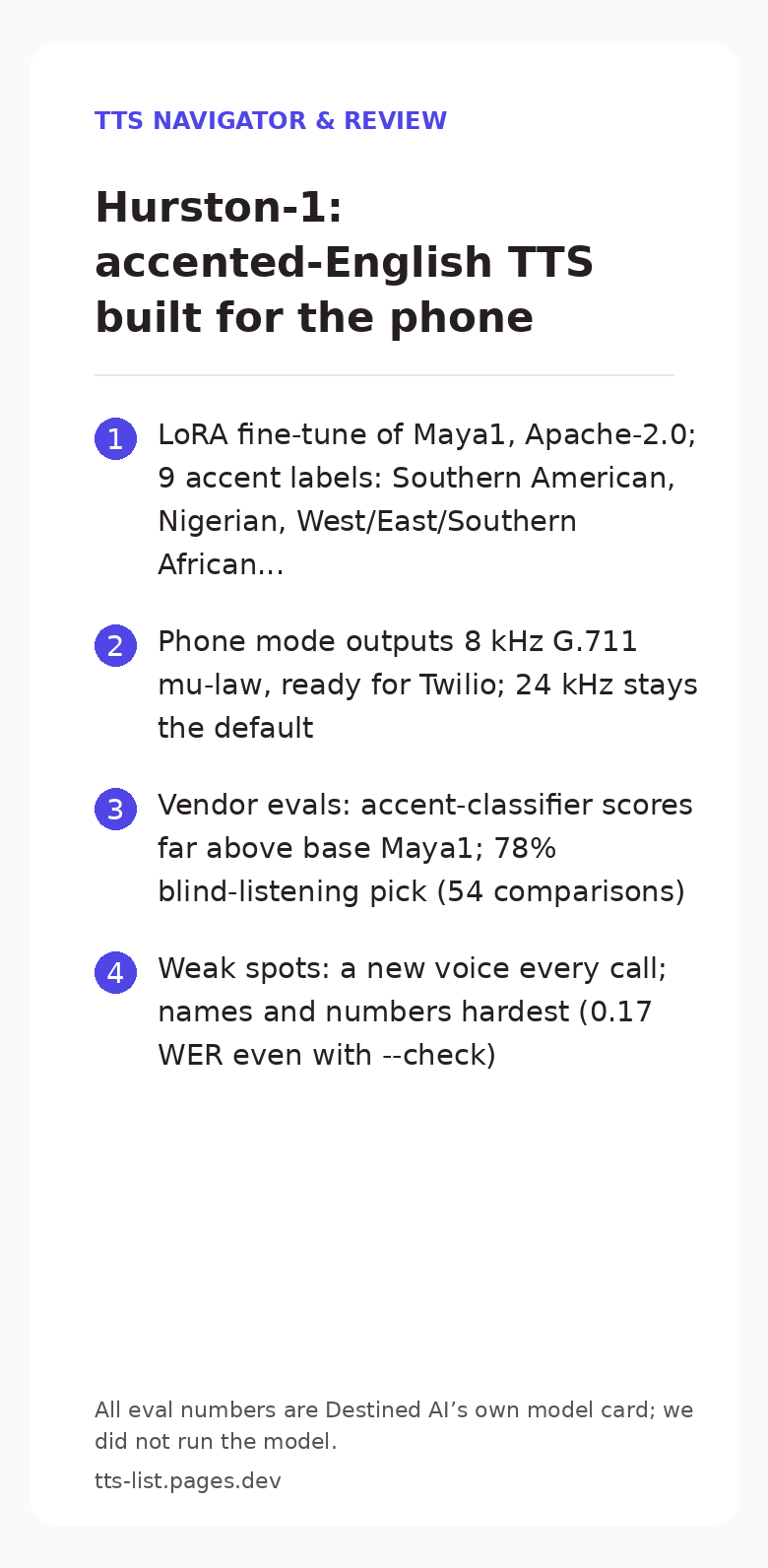
Most TTS demos are studio-quality audio that then gets deployed over an 8 kHz phone line - and most TTS models flatten accented English into generic American. Hurston-1, released by Destined AI (a small Atlanta team) and trending on Show HN this weekend, attacks both problems at once: it is an open model for accented English, and it has a first-class "phone mode" that emits exactly what a caller hears. It is the first release in Destined AI's ClarityVoice family, and a LoRA fine-tune (rank 64, 2,000 steps, about 190 hours of speech) of Maya1, keeping the Apache-2.0 license.
What it is
- Accent coverage. Voice steering uses plain-language descriptions - gender, age, accent, style, pace. The accent label list: American, Southern American, Nigerian English, Nigerian (Yoruba) English, Nigerian (Igbo) English, West African, East African, East African (Swahili), and Southern African English.
- NB-TTS (narrowband TTS). Phone mode band-passes the output to the 300-3,400 Hz telephone band, resamples to 8 kHz, and encodes G.711 mu-law (
--codec alawfor A-law) - the payload format Twilio media streams and SIP systems expect. Aulaw_encode()helper returns raw mu-law bytes. 24 kHz full-band audio remains the default; phone mode is a channel effect applied after synthesis. - Trained partly on real calls. About 10 hours of the training audio - 7,600 turns from 250 contributors - is phone-quality speech from real calls between consented, paid contributors and full-duplex AI voice agents, alongside studio-style reading and conversation.
- No voice cloning. Each call samples a fresh voice fitting the description; the model was not trained to reproduce any real person. Pace labels map to measured speaking rates (slow under 2 words/sec, natural 2.6-3.4, fast over 3.4) and are followed approximately.
- A
--checkretry loop. The runner re-generates takes that Whisper cannot follow or where the voice shifts mid-take - the card's own numbers below show why it matters.
The Hugging Face repository is public but gated: you must accept conditions on the model page before downloading files.
The evaluation - Destined AI's own numbers
All of the following comes from the model card's evaluation section, run by Destined AI.
Accent strength vs base Maya1
An accent classifier (African vs American English, trained on real speakers) scored 180 clips per model, with base Maya1 prompted in its own documented style:
| Accent (probability judged African) | Maya1 base | Hurston-1 |
|---|---|---|
| Southern African | 0.60 | 0.95 |
| West African | 0.60 | 0.84 |
| East African | 0.81 | 0.98 |
| Nigerian | 0.82 | 0.94 |
| American (should be low) | 0.12 | 0.02 |
| Southern American (should be low) | n/a | 0.01 |
The classifier cannot distinguish Southern American from general American, so that accent was verified by listening - worth knowing before quoting the table.
Intelligibility
Whisper large-v3-turbo word error rate against input text (lower is better):
- Everyday sentences (180 clips, natural pacing, single take): mean WER 0.02 for Maya1 base vs 0.03 for Hurston-1.
- Harder sentences (510 clips: reading, health, customer service, names and numbers, long expressive lines): 0.145 single-take, dropping to 0.062 with
--check; clips over 20% WER fall from 17.1% to 8.4%. - Names and numbers are the hardest category at 0.17 WER even with
--check- though the card notes part of that is the recognizer misspelling African names (e.g. "Adaeze Okafor") rather than mispronunciation.
Blind listening
testers heard the same sentence from both models in random order and picked the more accent-authentic one: Hurston-1 was chosen 78% of the time, base Maya1 6%, the rest tie or neither (54 comparisons). Base Maya1 was never preferred for an African or Southern American voice; its few wins were plain American English.
Training data and licensing
| Source | Hours | License |
|---|---|---|
| Destined AI accented-English corpus (scripted, conversational, ~10 h real phone calls with AI agents; consented, paid adult contributors) | ~136 | Owned by Destined AI |
| LibriTTS-R (audiobook style) | ~46 | CC BY 4.0 |
| Mozilla Common Voice English, African-accented speakers, quality-filtered | ~10.5 | CC0 |
Accent labels come from contributors' self-reported background, cross-checked with an audio classifier and human listening; mismatches were relabeled or removed. The full 1,800+ hour Destined corpus (recorded since 2021) is not in this release - the company offers it under separate licensing. The model itself is Apache-2.0, following Maya1.
Limitations (from the card itself)
- No voice consistency across calls - and because long text is split into ~40-word chunks, the voice can change between chunks of one generation. Named consistent voices are planned, not shipped.
- The generic "African English" label is weak (WER 0.26) - use a specific region label instead.
- Names, dates, and amounts are the weakest content; the card says to use
--checkand listen before shipping anything important. - English only, no child voices. Occasional garbled or overlong takes and mid-take voice shifts still happen (
--checkcatches most). - Phone mode changes the channel, not the behavior: the model does not yet do call-style delivery (turn-taking, backchannels). That "telephony-native" model is listed under What's next.
Who should care
- Voice-agent builders testing accent robustness. The card's first suggested use is generating accented test data: run the same sentences through nine accents and find where your ASR or your agent breaks before real callers do.
- Telephony products. IVR menus, appointment reminders, and simulated callers that drop straight into Twilio as mu-law - no transcoding step.
- Teams whose users don't sound like a default American voice. Read-aloud, onboarding, and announcements in a voice closer to the community served - with synthetic-use labeling, as the card asks.
The model is named for Zora Neale Hurston, the anthropologist who recorded how Black Southerners actually spoke; the card notes the name is a tribute and implies no endorsement by her estate.
Caveats
- All evaluation numbers are Destined AI's own published results on its own test sets; none are independently reproduced here. We did not run the model.
- The 78% blind-listening figure comes from 54 comparisons - a small sample, run by the vendor.
- The HF repo is gated: you must accept conditions on the model page to access files.
Sources (all read in full; links verified October 26, 2026)
- destined/hurston-1 (Hugging Face model card) - all capability, evaluation, training-data, and license claims above.
- Show HN: Hurston-1 open source TTS (Hacker News, October 25, 2026) - release context.