GRT-30M-TTS: A Transformer With Zero Linear Layers Learns to Speak
November 6, 2026 - by TTS Navi. We read the model card and the base-model whitepaper; every number below is the author's own report unless marked otherwise.
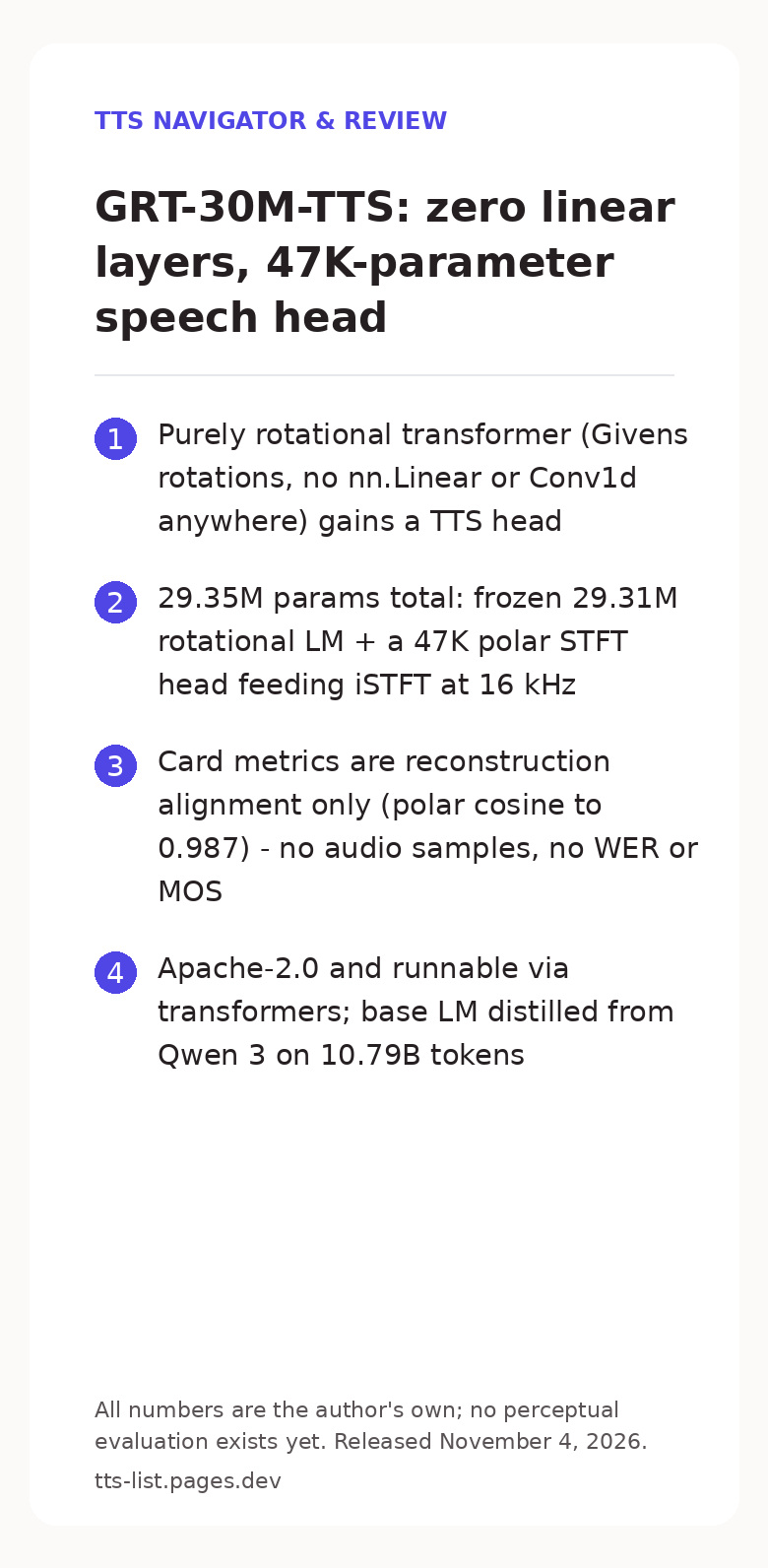
Every transformer you have ever used computes with dense weight matrices. GRT-30M-TTS (MatterWave AI, David Householter) computes with rotations instead: a 29.35M-parameter text-to-speech model with literally zero nn.Linear and zero nn.Conv1d layers anywhere in the stack. It is the newest member of the GRT-30M research suite - a nine-repository Hugging Face collection built on the Geometric Rotation Transformer, where every projection is a chain of Givens rotations with content-dependent Clifford coupling, token embeddings live as phase angles plus a log-magnitude, and the output head is a cosine softmax. The base 29.31M-parameter language model was distilled from Qwen 3 on 10.79B tokens (whitepaper-reported: 24 hours on 8x A100, validation perplexity 88).
The speech part is tiny - and frozen-base
The TTS capability comes from a 47,361-parameter "polar vocoder head" attached to the frozen language backbone (frozen to preserve text fluency). The head is a 15-stage Givens butterfly expansion, a radial GELU, and a 15-stage contraction that emits 128 complex STFT bins per step at 4 frames per token, turned into 16 kHz audio by an inverse STFT. Usage is standard transformers: a chat-style prompt like Speak (alto, declarative): hello matter wave goes in, a waveform tensor comes out. The parenthetical style hint in the prompt implies some degree of instructable voice character, though the card documents no style-control evaluation.
What the reported metrics actually measure
The card's headline numbers need careful reading. "Frame polar cosine similarity -0.078 to 0.987" and "spectral SNR -6.99 dB to 12.03 dB" describe the head's training alignment - how closely the generated STFT frames match their target frames before and after the alignment procedure (dubbed "Sophia-Torus"). These are reconstruction-fidelity numbers on the training objective. They are not intelligibility scores, not listening tests, and not comparisons against any other TTS system. The card links no audio samples and reports no WER, MOS, or speaker-similarity evaluation. Whether the output is clearly intelligible speech is, as of the card, unverified by any public perceptual evidence.
Context: an architecture experiment, not a product
The GRT project is one researcher's bid to replace the dense matrix as deep learning's computational primitive - the whitepaper claims 2x fewer stored parameters than a same-shape dense transformer at d=256, extrapolating to 42x at a GPT-3-equivalent shape. The base model's whitepaper results (perplexity 88 after a 24-hour Qwen 3 distillation, "outperforms random chance on 6 of 7 zero-shot benchmarks") frame GRT-30M as a working proof-of-concept rather than a competitive LM. Notably, the whitepaper does not mention TTS at all: the speech head exists only in the model card, so nothing about it has even informal peer documentation beyond the author's own repo. Apache-2.0, runnable today.
Our analysis
Why cover a 29M-parameter experiment with no audio samples? Because it marks a category boundary: TTS heads are migrating onto architectures that were never designed for speech, and a purely rotational network producing waveforms through a fixed iSTFT is a genuinely new data point on what a "TTS model" can be made of. The 47K-parameter speech head is either impressive economy or a ceiling on quality - without perceptual evaluation, nobody knows, and the honest answer is that this is a research artifact to probe, not a model to ship. If the author publishes listening samples or a third party runs an intelligibility pass, that is the follow-up worth watching. Until then: architecturally fascinating, perceptually unproven.
Sources
- MatterWaveAI/grt-30m-tts model card (read in full, November 6, 2026)
- MatterWaveAI/grt-30m (base model + GRT whitepaper)