Training a Vocoder Against the Detector: TTS That Evades Deepfake Detection
November 6, 2026 - by TTS Navi. We read the full paper; all experiments and numbers below are the paper authors' (arXiv 2611.04511), not ours.
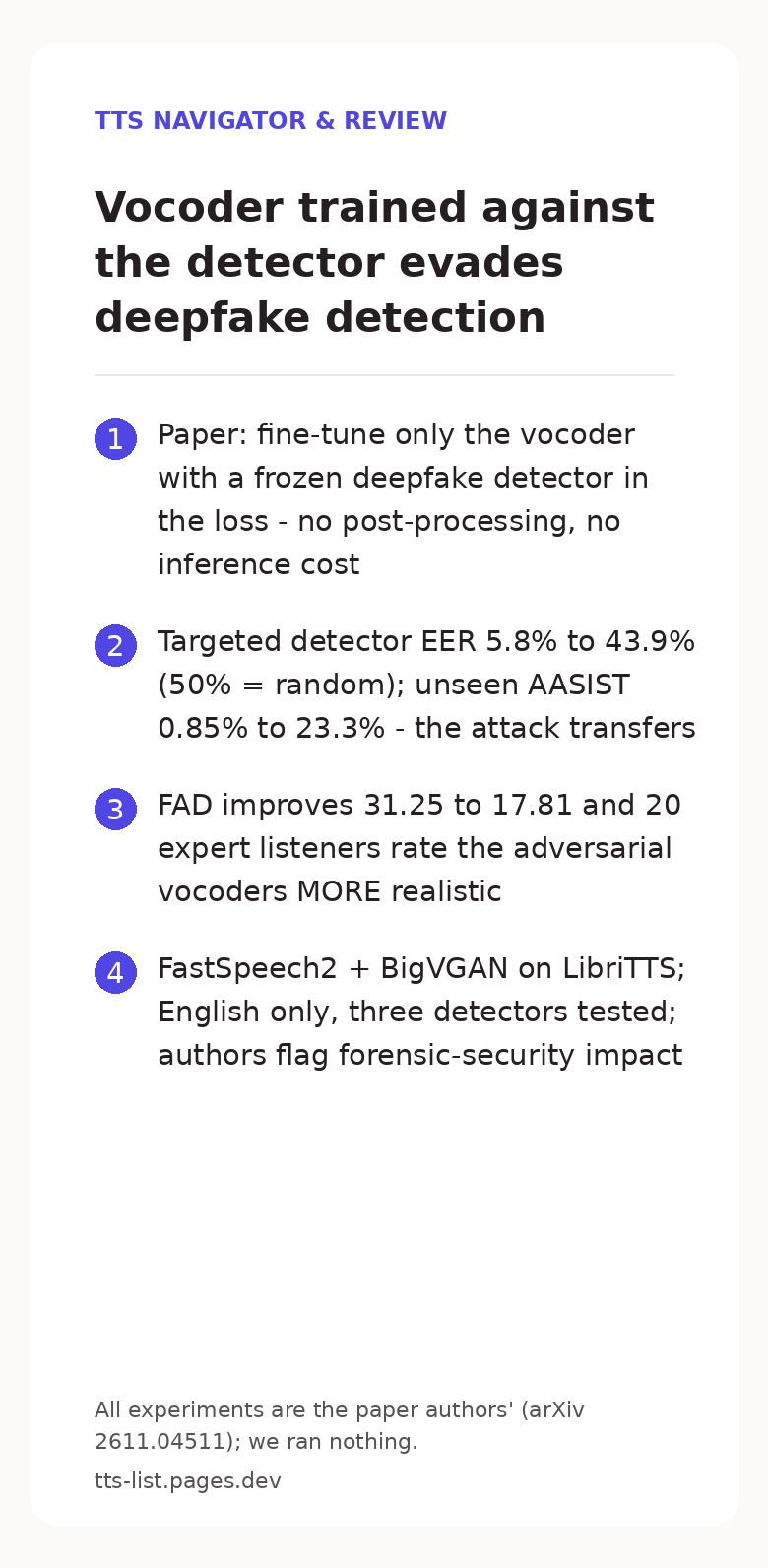
Adversarial attacks on speech deepfake detectors are usually post-processing tricks: add a learned perturbation to the finished audio and hope it transfers. A new paper from the multimedia forensics group at Politecnico di Milano (Cui, Salvi, Bestagini, Tubaro) moves the attack inside the synthesizer: fine-tune the vocoder with a frozen deepfake detector wired into the training loss, and the TTS system learns to produce speech that is intrinsically adversarial - no noise injection, no post-processing, and zero added inference cost, because the evasion is baked into the waveform generator itself.
How it works
The pipeline is a conventional two-stage TTS: an enhanced FastSpeech2 acoustic model (with utterance/phoneme-level encoders, pyannote speaker embeddings and random-window discriminators) produces mel-spectrograms, and a BigVGAN vocoder turns them into waveforms. The acoustic model stays frozen; only the vocoder is fine-tuned, with a composite loss: the original BigVGAN training objective plus a binary cross-entropy term that rewards the detector for calling the output authentic. The detector's own weights are frozen - gradients flow through it only to update the vocoder. A multi-detector variant optimizes against two detectors at once (RawNet2 and TSSD), and a third detector (AASIST) is held out entirely to test black-box transfer. Training data is LibriTTS.
What the paper reports
All numbers below are the authors' experiments. Detection performance is measured as EER (50% = random guessing), so from the attacker's perspective higher is better:
- Baseline vocoder: detectors are near-perfect - RawNet2 EER 5.8%, TSSD 3.4%, AASIST 0.85%.
- Vocoder fine-tuned against RawNet2 only: RawNet2 EER jumps to 39.05%; TSSD, never targeted, also collapses to 38.33%; even unseen AASIST degrades from 0.85% to 21.09%.
- Vocoder fine-tuned against RawNet2 + TSSD jointly: both targets go past 43% EER (balanced accuracy ~55-57%, near random), and AASIST rises further to 23.26% - joint optimization transfers better than single-target, suggesting the vocoder learns to suppress forensic cues shared across detector architectures rather than overfitting one.
The unexpected result is quality. Frechet Audio Distance against real speech improves at each stage: 31.25 (baseline) to 22.95 (single-detector) to 17.81 (multi-detector), roughly 25% per stage. And in a MUSHRA-like listening test with 20 expert listeners, the adversarially fine-tuned vocoders were rated more realistic than the baseline, progressively approaching real audio. The authors' hypothesis: deepfake detectors key on subtle synthesis artifacts that are also perceptually undesirable, so suppressing detector-relevant cues simultaneously fools the machine and pleases the ear. They flag this as a hypothesis needing further validation.
Why it matters - and its limits
For the forensics community this is a sobering result: a one-time offline fine-tune turns a stock open TTS pipeline into a generator that pushes three state-of-the-art detectors toward coin-flip territory, including one it never saw, with no runtime cost and no telltale post-processing step. Detector evaluation protocols that train and test against the same generator (as this paper's own detectors did) will need adversarially-retrained generators in their training mix to stay meaningful. The authors state the work's potential impact on forensic security and detection countermeasures directly.
Scope limits to keep in mind: everything here is English LibriTTS speech from one TTS pipeline (FastSpeech2 + BigVGAN), tested against three end-to-end waveform detectors - not against the latest large commercial cloning systems or codec-based detectors. The perceptual gains come from 20 expert listeners on one dataset. And the transfer result, while consistent, shows AASIST at ~21-23% EER - degraded, not blind. The paper is CC BY 4.0.
Our analysis
Read together with yesterday's VIPBench findings - where listeners heard 41% of commercial clones as a different person while speaker models stayed miscalibrated on synthetic audio - a pattern emerges: both our human and machine "is this really them / is this real" judgments are measurably weaker than production TTS assumes. This paper adds the offensive counterpart: those machine judgments can be degraded further, for free, at training time. The quality-improvement side effect deserves attention beyond security: "train the vocoder against a critic that knows what fake sounds like" is a recipe any TTS team can adopt for legitimate quality gains, essentially a forensic-flavored GAN objective with the discriminator frozen. Expect detector-guided fine-tuning to show up in vocoder recipes - and expect detector benchmarks to start including it as a standard attack condition.
Sources
- Detector-Guided Vocoder Training for Adversarial Text-to-Speech Synthesis (arXiv 2611.04511, read in full)