Cartesia Managed Agents: the Sonic maker ships a full voice-agent platform - #1 on Artificial Analysis's agent arena
Published November 1, 2026 · Built from Cartesia's launch post, read in full on November 1, 2026. The Speech Agent Arena result is Artificial Analysis's own blind-rated board; EVA-Bench scores are Cartesia-reported on ServiceNow's open benchmark; the turn-taking figure is Cartesia's internal evaluation - each is labeled. We did not test the platform.
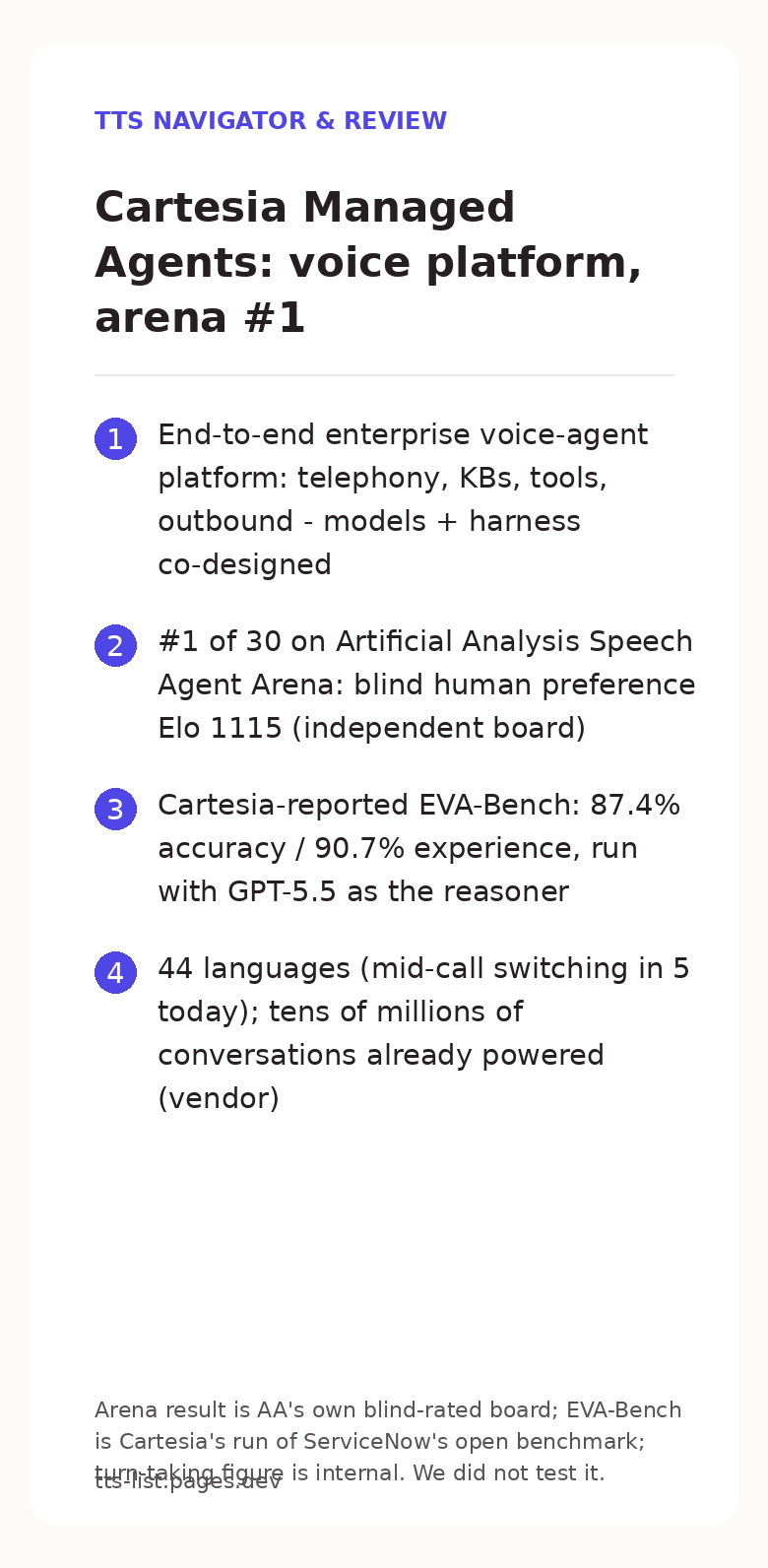
Cartesia - the company behind the Sonic TTS line - has launched Managed Agents, an end-to-end voice-agent platform for enterprise calls: telephony, knowledge bases, tool integrations and outbound campaigns in one product, with its voice models and the agent harness "designed together." Cartesia says it has already powered tens of millions of conversations in finance, retail, hospitality and healthcare ahead of launch.
The independent result - and the vendor-reported one
- Artificial Analysis Speech Agent Arena (independent): Managed Agents ranks #1 of 30 agents with a preference Elo of 1115 - blind human raters comparing agents on tasks like booking appointments and ordering takeout, October 2026 board. Ahead of Gemini 3.1 Flash Live Minimal (1099), Gemini 3.8 Live (1079), Grok Voice 3.0 (1064), GPT-Live-1 configs (1041/1037) and Eleven Realtime v1 Max (1003). This is AA's own blind-rated arena, not a vendor-run harness.
- EVA-Bench (Cartesia-reported, ServiceNow's open benchmark): EVA-A accuracy 87.4% and EVA-X experience 90.7% - the top corner of Cartesia's chart, run with GPT-5.5 as the reasoning model. The launch post carries a supportive quote from ServiceNow's agentic-evals PM, but the scores as published are Cartesia's run of ServiceNow's benchmark - same labeling discipline we applied to Rime Prism's self-run τ-Voice numbers this week. For calibration: yesterday's Apriel Voice 27B (a raw open model, not an agent platform) posted 51.27/74.13 on the same benchmark family in ServiceNow's own runs.
- Internal: callers reported no turn-taking issues in 85% of conversations vs 67% for "other agents" - vendor-internal evaluation, no methodology published.
The architectural claim
Cartesia's pitch lands in the same fight as Phonic-1 and Rime Prism this week, from the opposite corner: cascades (ASR → LLM → TTS) are reliable but lose naturalness and turn-taking; fused speech-to-speech sounds human but is "hard to control." Cartesia's answer is co-design - keep a controllable harness, but tune listening, turn-taking, reasoning, tool-calling and speech as one system. Notably it does not claim to be end-to-end S2S; it claims the harness-plus-models combination beats both paradigms on enterprise tasks.
What's in the platform
- 44 languages, with mid-conversation switching between English, Spanish, Hindi, French and Japanese today - "all 44 coming soon."
- Tool calls into backend APIs/CRMs; knowledge bases prefilled dynamically "so it responds without pausing to search"; outbound batch campaigns.
- No public pricing in the launch post; it is an enterprise platform play.
Why it matters
- The TTS providers are becoming the agent companies. Cartesia (Sonic), Rime and Phonic all now sell the whole call, not the voice - the voice model is becoming the retention layer underneath an agent product.
- Blind human preference is the metric that matters for calls, and an independent arena putting a newcomer above every Google/OpenAI/xAI entry - on launch day - will force the big labs to post their own arena numbers.
- Watch the reasoning-model dependency: the headline EVA-Bench config runs GPT-5.5 - how much of the 87.4% is Cartesia's harness and how much is the frontier LLM behind it is exactly what buyers should A/B.
Sources (read in full; links verified November 1, 2026)
- Introducing Managed Agents - Cartesia (October 29, 2026) - primary: platform scope, Speech Agent Arena table, EVA-Bench chart and scores, ServiceNow quote, internal turn-taking figure.