ZONOS3-Mini: 100M active parameters, voice cloning in the browser, and a benchmark its own vendor built
November 13, 2026 - by TTS Navi. We read Zyphra's release post and both model cards in full; every performance number below is Zyphra's own measurement, most of it on Zyphra's own new benchmark.
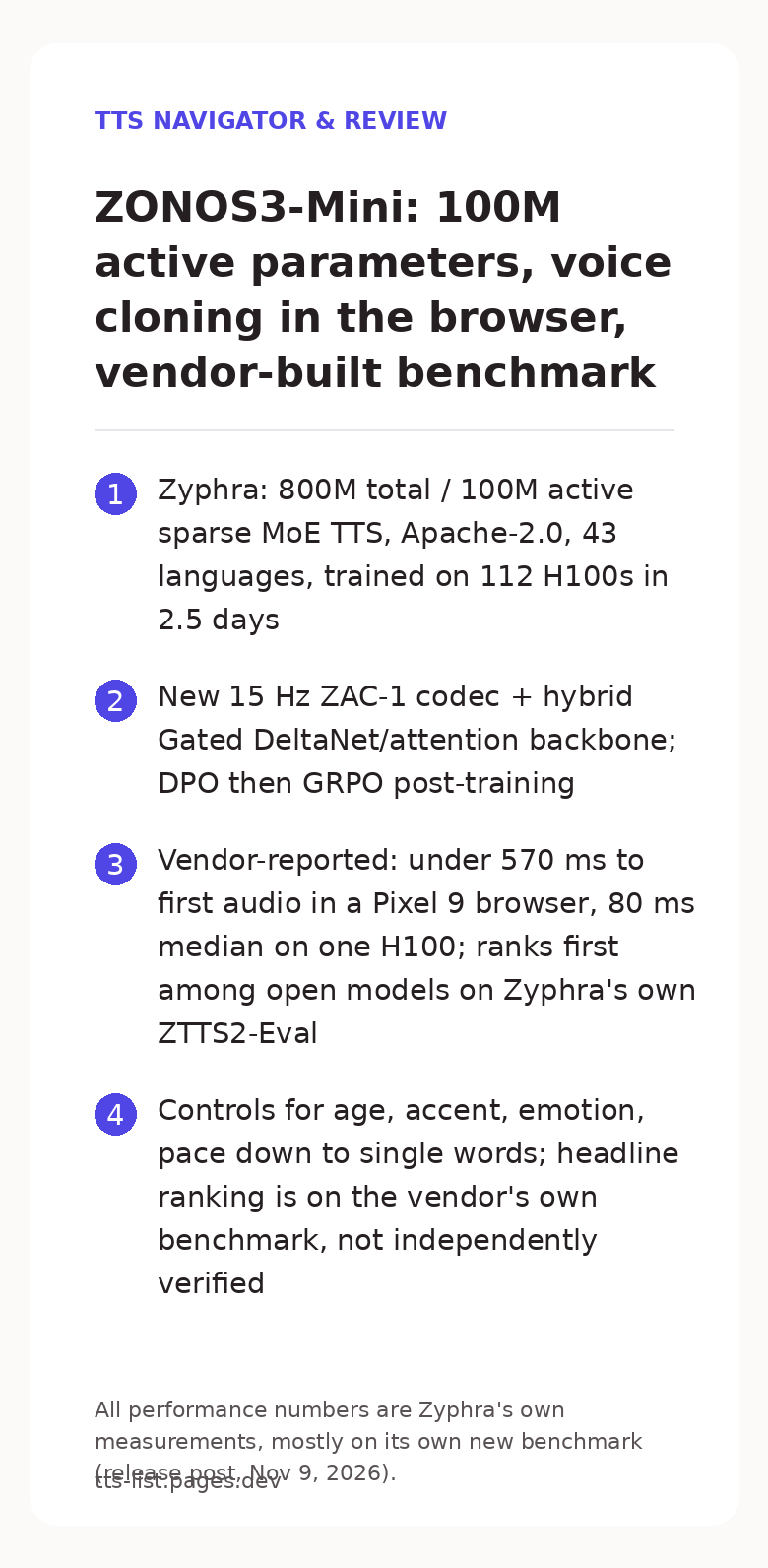
Zyphra has released ZONOS3-Mini, a sparse Mixture-of-Experts text-to-speech model with 800M total and about 100M active parameters per token, Apache-2.0 weights, and 43 languages. The release post is dated November 9; the base weights landed on Hugging Face the same day, a plain-transformers wrapper followed on November 11, and an official Hugging Face blog on November 12. The pitch is that the quality-versus-speed tradeoff no longer needs an 8B model: ZONOS2 reached quality with 8B parameters on an 86 Hz codec, and ZONOS3-Mini attacks every layer of that stack - a new codec, a hybrid linear-attention backbone, a new speaker encoder, and preference-based post-training. Zyphra says it trained the model on 112 H100s in 2.5 days, and that it clones voices in real time with under 570 ms to first audio in a phone browser (Pixel 9) and under 150 ms on an M3 MacBook Air.
What changed under the hood
Four changes, per the release post. First, the codec: Zyphra's own ZAC-1 replaces Descript Audio Codec, emitting 15 Hz dual-codec frames with ten 4,096-entry codebooks - one semantic codebook distilled from a Wav2Vec2-BERT teacher plus nine acoustic ones - rendered to 44.1 kHz by a causal multi-resolution iSTFT head as each frame completes. Zyphra reports that under similar data constraints a model trained with ZAC-1 cuts word error rate 10x against one trained with DAC, and matches leading TTS codecs (S1-DAC, MOSS v2) at better compression or beats them at similar compression. Second, the backbone: 11 layers at model dim 1,024 mixing Gated DeltaNet and global attention in a 3:1 ratio, with latent MoE (64 experts, top-2 routing, from layer 1), Q balancing and attention residuals, over a 32,768-position context; text is NeMo-normalized for nine languages (others pass through as written) and tokenized with an 8,192-entry SuperBPE. Third, the speaker representation moves from the Qwen3-TTS speaker encoder to the MECT-B2 verification model, with two conditioning modes: a raw reference clip encoded into a token prefix (up to 60 s, with speaker CFG), trained from pretraining, or a single 192-d embedding, fine-tuned in a short later stage. Fourth, post-training: DPO then GRPO for robustness.
Controls and serving
The release leans hard on steerability. Age, gender presentation, accent and vocal texture are steered through speaker-embedding vectors (with task vectors for accents); pace, emotion, projection and liveliness through activation steering; and delivery down to individual words through alignment attention-head monitoring during streaming, plus a VoiceCraft-recipe edit model for after-the-fact sentence edits. Three bucketed acoustic control rows (loudness in LUFS, bandwidth, speaking rate in UTF-8 bytes per second) are exposed at generation. Zyphra is careful to frame the sliders as targets: "perceived traits and speaker consistency should be assessed by listening." Serving options are unusually broad for day one: a WebGPU build that runs entirely in the browser (a full Voice Studio and a Lite cloning page), SGLang-Omni with an OpenAI-compatible /v1/audio/speech endpoint, native CUDA and MLX servers, and a C++/ggml CLI and server for CPU, CUDA, Metal or Vulkan, loading GGUF files; a transformers wrapper runs the checkpoint with trust_remote_code. On one H100, Zyphra measures 80 ms median time-to-first-audio at 8 concurrent requests and 457 seconds of audio per second at peak throughput.
The evaluation - and who built it
Alongside the model, Zyphra releases ZTTS2-Eval, expanding its earlier ZTTS1 benchmark: FLEURS-R read speech in 35 languages plus VoxBlink2 in-the-wild recordings in 20, scored with Qwen3-ASR supplemented by Whisper Large v3 in lower-resource languages, new rhythm and pitch-distribution metrics replacing TTSDS2, and a masked-prosody-model embedding distance with a scrambled-input floor. On top of 420 items (metric x test set x language) it builds a "Zyphra TTS Capability Index v1" using item response theory. Zyphra's result: ZONOS3-Mini ranks first among open models, followed by Fish S2 Pro and MOSS TTS v1.5. All of this is vendor-reported on a vendor-built benchmark, and the qualitative comparisons against Fish Audio, Qwen, Cartesia, ElevenLabs and OmniVoice are vendor-picked samples - the post itself argues listening is the real test.
Our analysis
The engineering story is coherent and each piece is checkable in the weights: a 15 Hz codec (against DAC's 86 Hz) is what makes 100M active parameters sufficient, and the 3:1 GDN/attention hybrid is the same pattern LLM serving has converged on for long-context throughput. The two-mode speaker conditioning is a thoughtful split - in-context codes for naturalness, embedding for tractable steering - and releasing an edit model plus word-level steering acknowledges how these systems are actually used in production. The caution flag is evaluation sovereignty: the headline ranking rests on ZTTS2-Eval and a capability index that Zyphra designed, scored and indexed itself, and "first among open models" should be read as "first on our own yardstick" until independent runs appear - the same disclaimer we apply to every vendor benchmark, including the ones we like. Text normalization only covering nine languages means the long tail of the 43 relies on as-written input, which historically is where multilingual WER hides. None of that diminishes the release's practical value: Apache-2.0 weights with working browser, server and edge runtimes on day one is more than most TTS releases ship, and the voice-design controls will matter more to app builders than the index rank.
Sources
- ZONOS3-Mini release post (Zyphra, November 9, 2026) (read in full, November 13, 2026)
- ZONOS3-Mini base model card (Hugging Face) (read in full)
- ZONOS3-Mini-hf transformers wrapper card (read in full)
- Official Hugging Face blog post
- ZTTS2-Eval benchmark site