Speko's TTS benchmark: naturalness at the top is a nine-way tie, so the useful axes are robustness, latency and price
November 27, 2026 - TTS Navi. We read the benchmark pages and the methodology post in full. Speko built and runs this benchmark and sells voice-agent routing; all figures are Speko's own measurements, not our tests.
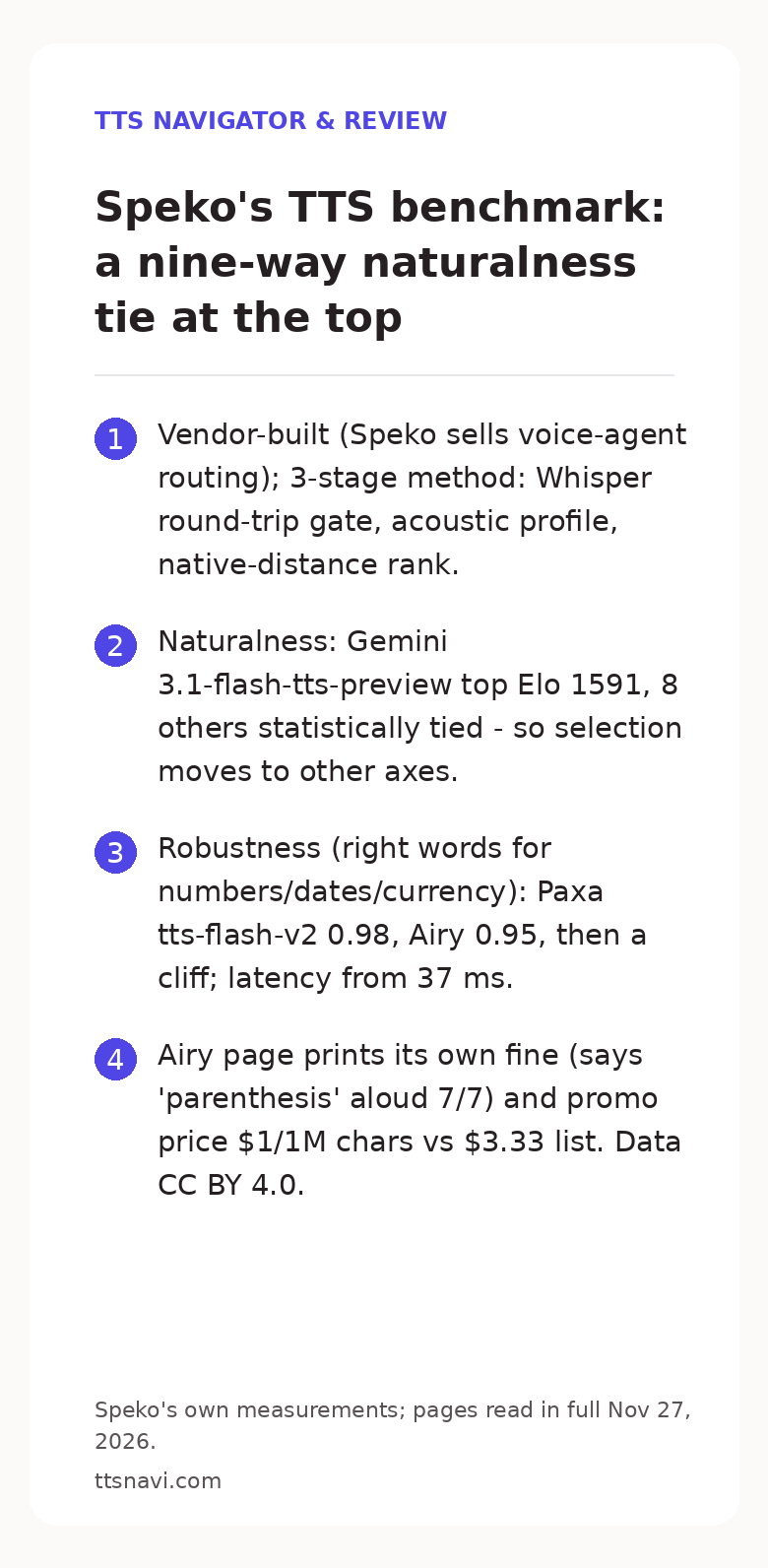
Speko - a voice-agent platform that sells routing and agents, so read this as a vendor-built benchmark on a marketing site - publishes public TTS measurements across 40+ models with a method that refuses to collapse everything into one score. Per its methodology post (June 8, 2026), the pipeline is three stages: an intelligibility gate (synthesize, transcribe back with Whisper-large-v3, check character error rate and that the detected language is even the target one - catching engines that silently fall back to English), an acoustic profile (jitter, shimmer, prosody against a natural band from 24 audiobook speakers, where being below the human band means too clean, not better), and a nativeness rank (distance to a native speaker's recording of the same FLEURS sentence in a speech-encoder space, reporting 0.99 Spearman agreement with a native listener on Thai, 0.897 on Indonesian).
The headline: a tie at the top, so look sideways
Speko's own summary line: Gemini 3.1-flash-tts-preview holds the highest naturalness Elo (1591, blind listening tests, as of July 2026) - and 8 other models are statistically tied with it. When nine models tie on naturalness, selection moves to the other axes, and those separate sharply. Robustness (does the voice say the right words for a number, date, currency amount or operator): Paxa tts-flash-v2 leads at 0.98, Out of Set Airy TTS second at 0.95, then a cliff - ElevenLabs eleven_v4 0.90, and Qwen qwen3-tts-flash, the naturalness co-leader's sibling, down at 0.15. Time to first audio (US East): Nari Qwen3-TTS Fast 37 ms p50, Inworld tts-2-flash 43 ms, Paxa tts-flash-v2 45 ms. Cost per million characters at list rates runs $1 to $100+.
The Airy re-test shows what per-model pages carry
The Airy page (measured November 18, 2026) prints robustness 0.95 with the failure attached: sent "So (3+4)x2=14 in total", it said "open parenthesis" out loud in 7 of 7 transcripts - a minor fine, marked promptable. A drift test (three 20-take runs) found all 60 takes differ but barely (mean pairwise distance 0.0097 vs 0.0959 for Deepgram aura-2). Price measured November 24: $1 per 1M characters as a launch promo through 2026-12-25, list $3.33 after - so any older figure you see quoted is stale. Data is CC BY 4.0 with embeddable badges. The numbers are Speko's measurements on Speko's pipeline; the disclosure that matters is that the same company sells the router these scores feed.
Sources
- https://speko.com/benchmarks/tts
- https://speko.com/benchmarks/tts/out-of-set-airy-tts
- https://speko.com/blog/benchmarking-tts-end-to-end