REAL: a TTS reward model that has to show its evidence
November 11, 2026 - by TTS Navi. We read the full paper; all results below are the authors' own experiments, not ours.
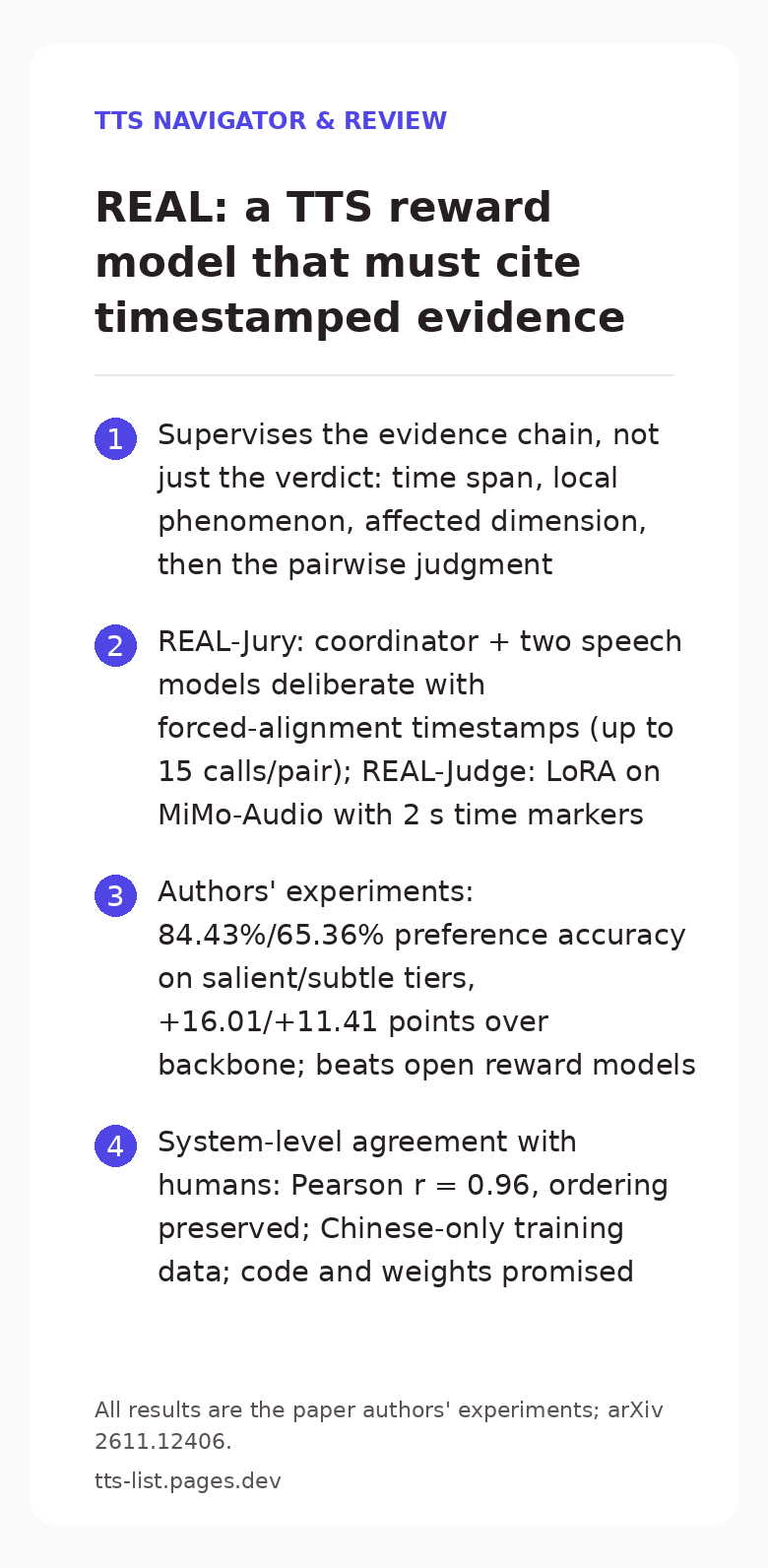
As TTS systems converge on intelligibility, the useful evaluation question has shifted from "did it read the words" to "did it sound alive" - and listening tests are too slow to answer that at development speed. REAL (Reward modeling through Evidence-linked Analysis of Lifelikeness, arXiv 2611.12406, from Yaodong Song, Jie Lian, Zhen-Hua Ling and colleagues) attacks the credibility problem inside automatic judges: existing speech reward models emit scores and rationales, but nobody verifies that the rationale's claims about the audio are true. REAL's answer is to make the evidence itself a supervised target.
The three-part design
REAL-Jury builds training data by deliberation: a coordinator model (DeepSeek-V4-Pro) collects independent analyses from two speech-understanding models (Qwen3.5-Omni and Step-Audio-R1.1) without letting them see each other's answers, grounds every observation in character-level timestamps from a forced-alignment model, then interrogates disagreements with targeted follow-up questions (up to 15 model calls per pair) until claims are reconciled. The output is a structured report that chains each judgment down to a time span, a local phenomenon, and the perceptual dimension it affects; reports whose final preference disagrees with the human label are discarded. REAL-Judge distills 11,947 of these reports (built from the public SpeechJudge dataset) into a single reward model - MiMo-Audio-Instruct plus a LoRA (rank 64), with explicit time-marker embeddings inserted every 2 seconds so observations can be localized. REAL-Eval is a two-tier benchmark: Standard (400 Chinese pairs with salient defects, from SpeechJudge-Eval) and Fine (207 pairs comparing four strong systems - OmniVoice, Qwen3-TTS-1.7B-Base, VoxCPM2, CosyVoice3 - across six text domains, annotated by ten raters with a 7:3 majority requirement, disjoint from training in texts, speakers, and source systems).
The authors' numbers
A lower-CER heuristic agrees with human preference on only 18.75% of Standard pairs and 6.76% of Fine pairs - transcription accuracy is nearly useless for judging delivery, which is the paper's motivating point. REAL-Judge raises its backbone's preference accuracy from 68.42% to 84.43% on Standard (+16.01 points) and from 53.95% to 65.36% on Fine (+11.41 points), beating the open-source reward models SpeechJudge and UniSRM and the open speech-understanding models on both tiers. It is not the overall winner: on the Fine tier it trails the closed Gemini-3.1-Pro-Preview by 1.95 points and Qwen3.5-Omni by 2.27 points. Ablations credit the time markers (+1.51/+1.59 points; 1-second markers are worse than 2-second) and the jury deliberation (80.92% vs 79.82% for the best single constructor). Aggregated to the system level, predicted win rates track human ones with Pearson r = 0.96 and preserve the ordering of all four systems, though predictions compress toward the middle (Qwen3-TTS underestimated by 14.6 points, OmniVoice overestimated by 13.4).
Limits, as stated
Training data is Chinese-only (English is future work, alongside on-policy distillation and RL); the Fine tier is 207 pairs, and even after training the judge is barely above two-thirds accuracy on the hardest comparisons; and the jury pipeline itself depends on closed models (DeepSeek-V4-Pro) for data construction. The authors say code and model weights will be released.
Our analysis
This is the evaluation paper the current TTS moment needs. This week alone we covered a model whose naturalness claim rests on its own internal judge (M5-TTS's VoiceJudge); REAL is essentially a blueprint for why such judges can or cannot be trusted - supervise the evidence chain, not just the verdict, and filter rationales that can't be grounded in the audio. The honest framing continues into the results: the authors show the closed-model gap, the calibration compression, and the small Fine set rather than hiding them. If the promised weights ship, REAL-Judge becomes a practical pre-screening tool for anyone iterating on TTS; if the benchmark gets adopted, "show me where in the audio" could become a standard demand for reward-model claims. Watch both.
Sources
- REAL paper (arXiv 2611.12406) (read in full, November 11, 2026)