LAION Humaneness Voice Large: open two-person podcast TTS in one acoustic take - and an unusually blunt card
Published November 4, 2026 · Built from the Hugging Face model card (laion/Humaneness-Voice-Large-NotebookLM-Edition), read in full on November 4, 2026. All measurements are LAION's own model/ASR estimates; we did not run the model. Card created November 2, 2026 - two days old at read time.
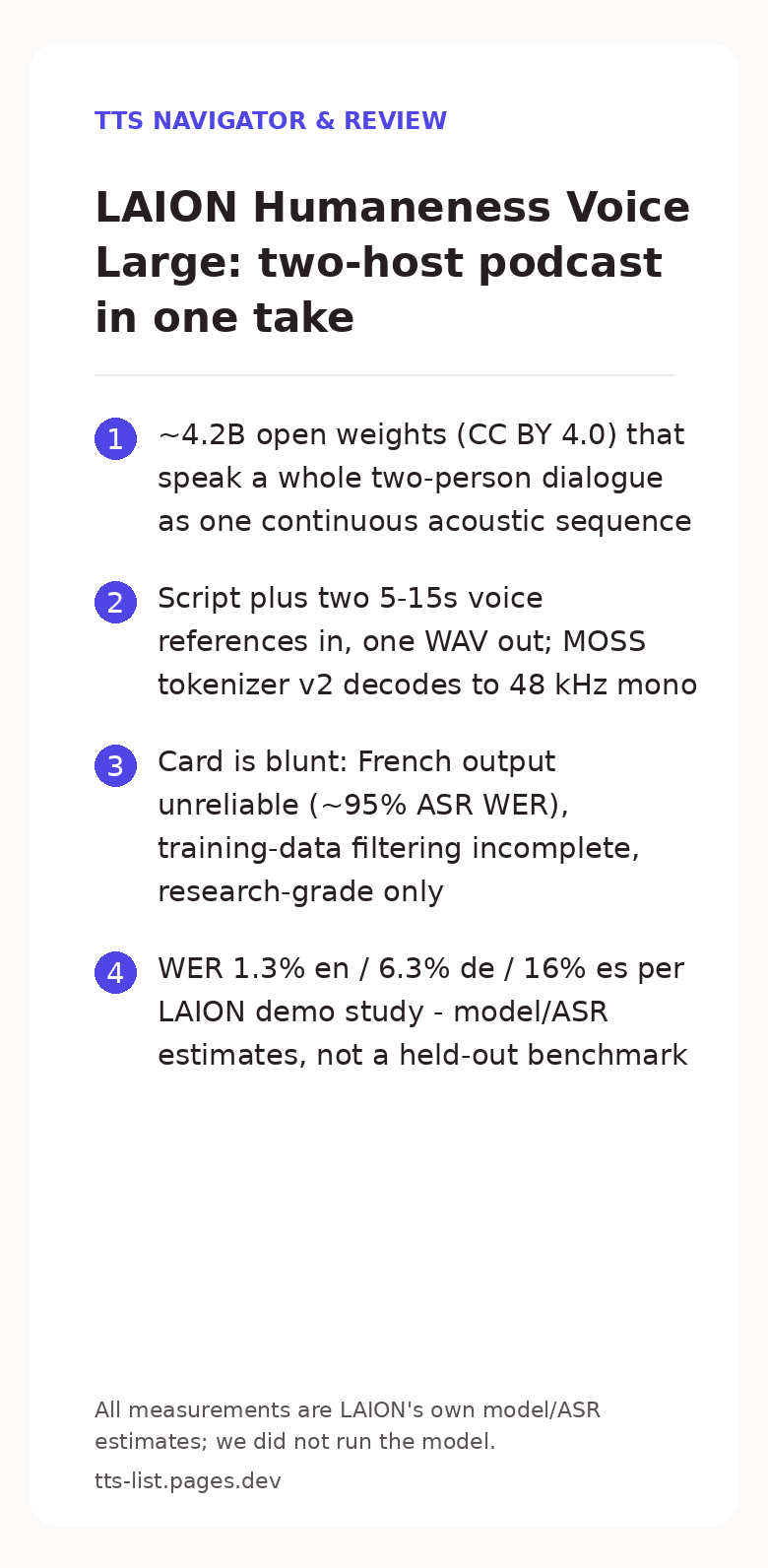
NotebookLM's podcast feature made "two hosts discuss my document" a mainstream audio format, but the open-weight ecosystem has mostly answered with pipelines that synthesize each turn separately and glue the files. LAION's Humaneness Voice Large - NotebookLM Edition takes the harder route: feed it a written dialogue plus two clean 5-15 second voice references, and it speaks the entire exchange as one continuous acoustic sequence - speaker switches, pauses and timing included, all sampled, not edited.
What shipped
- ~4.2B parameters, CC BY 4.0 weights. A 36-layer Qwen3-family semantic transformer (2,560-d) plus a one-layer local acoustic transformer, emitting 12 codebooks per 80 ms frame, decoded by MOSS Audio Tokenizer v2 to 48 kHz mono. Our check of the repo's BF16 safetensors totals 8.45 GB, consistent with the ~4.13B figure reported elsewhere. Fine-tuned from Humaneness Voice Large 1.3 Alpha with three epochs on filtered two-speaker podcasts plus a rank-64 quality-ladder fine-tune (already merged - do not reapply).
- The card's self-warnings are the story. It opens with an experimental-release notice: training-data filtering is incomplete, language labels unreliable, output quality varies "substantially." French output measured ~95% ASR word error and is explicitly called "an unreliable stress condition, not reliable French support." Dutch was dropped from advertising for unreliable publisher labels.
- Metrics are framed as demonstrations, not proof. On LAION's HQ reference study (new text, training-domain voices - "a demonstration, not a held-out-speaker benchmark"): per-clip ASR WER is 1.3% English, 6.3% German, 16% Spanish, 94.9% French; long clips run ~27% WER vs 18% short. The frozen comparison metrics "do not establish an overall automatic improvement" and "do not measure speaker-switch correctness" - the card says so itself.
- Practical honesty too. Requires a CUDA GPU, PyTorch 2.9.1/Transformers 5.14.1 tested stack; CPU not validated. Custom code needs trust_remote_code, and the card tells you to inspect it. References must be authorized voices; LAION asks you not to use it for deceptive impersonation.
Why it matters
- Whole-dialogue generation is a real architectural step. One continuous take means prosody can carry across turns - reactions can reference what was just said - which per-turn pipelines structurally cannot do. The trade-off: durations and speaker switches are "learned instructions, not hard constraints," so output stays stochastic.
- A useful contrast to this week's tiny-model releases. Same days, opposite end of the size spectrum: distilled sub-2M CPU models on one side, a 4.2B GPU model for a single well-defined format on the other. These solve different problems; size comparisons between them would be meaningless.
- For English and German podcast prototyping with voices you have rights to, this is the clearest open-weights path today - with the explicit understanding that LAION rates it research-grade, not production-ready.
Source (read in full; link verified November 4, 2026)
- laion/Humaneness-Voice-Large-NotebookLM-Edition - Hugging Face model card (created November 2, 2026) - install/run instructions, prompting contract, HQ study tables, evidence limits and licensing above. Listening examples are linked from the card.