One Background Voice Breaks Modern STT: Krisp's Voice Isolation Benchmark (September 2026)
Published October 21, 2026 · Built from the benchmark Space (including its embedded result data), the dataset cards, and Krisp's VI 2.5 engineering blog, all read in full. This is a vendor-run benchmark of the vendor's own product: every result number below is Krisp's measurement, not ours and not independently reproduced - we say so each time it matters.
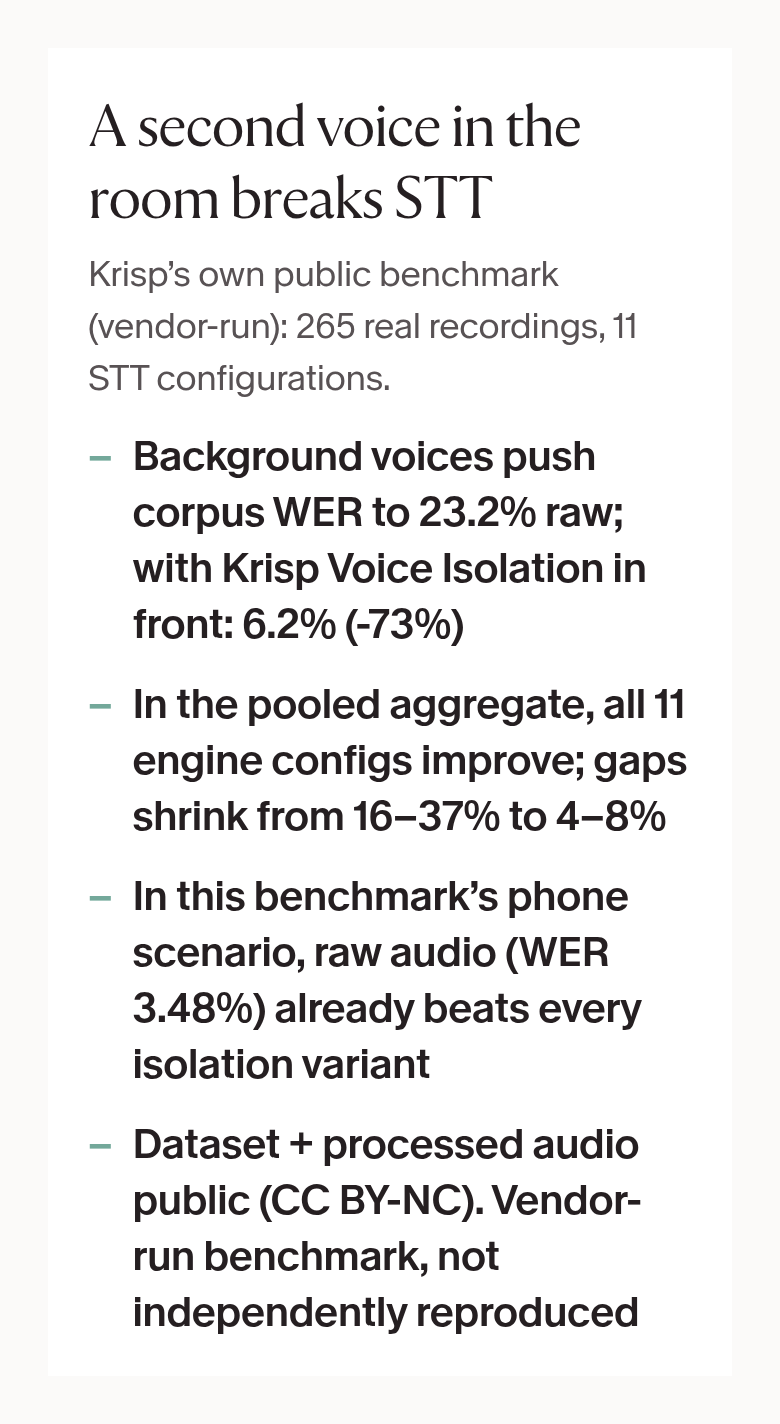
Modern speech-to-text handles fan noise and traffic fine. What still breaks it is a second person talking in the room: the engine transcribes the wrong speaker, and a voice agent takes its turn at the wrong moment. In mid-September, Krisp - the noise-cancellation company whose VIVA models it says run in over a billion minutes of voice-AI conversations per month - published a public benchmark for exactly this problem: 265 real recordings with background voices, run through 11 STT configurations twice, raw and after Krisp's Voice Isolation models. The headline: corpus word error rate falls from 23.2% to 6.2%, a ~73% relative reduction. It is a vendor benchmarking its own product - and it is also one of the most transparent vendor benchmarks we have covered, with the raw dataset, the processed audio, and the scoring code all public.
What was published
Three artifacts, all in mid-September 2026. The raw dataset (CC BY-NC 4.0): 265 recordings with hand-written, human-verified transcripts and time-stamped segment labels. The processed dataset: every Voice Isolation model's output on every file, so anyone can rescore the exact audio Krisp scored. And the results Space: headline tables, per-engine breakdowns, six listenable samples, and the full methodology including the text-normalization code.
The corpus: real rooms, real headsets, no synthetic mixing
The dataset card is unusually specific. 265 recordings, 47 speakers, 65 scripts, recorded by the Krisp team in real environments: 96 "work" recordings (29 speakers, 24 devices from AirPods to gaming headsets, four room types), 106 call-center recordings inside active call centers during normal workflow (7 speakers, 13 professional headsets, 4 locations), and 63 phone-call recordings (26 speakers, 18 phone models, mostly from cars). Nothing was mixed or augmented afterwards. Most work and call-center recordings follow a four-step script: primary speaker alone, then a second person joins, then only the second person talks, then both again. That "secondary-only" window is the stress test - the correct transcript for it is empty, and most engines transcribe the background voice anyway. Phone calls deliberately contain no second speaker; they test whether isolation stays safe on band-limited audio where there is little to remove.
The results, as Krisp measured them
WER is computed with jiwer 4.0.0 at corpus level - errors pooled across every file in a scenario, not an average of per-file percentages - after a documented normalization pipeline (published in full on the Space) built on NVIDIA's NeMo text processing. The pooled table across all 11 STT configurations:
| Scenario | Raw audio WER | Best VI 2.5 model | Relative change |
|---|---|---|---|
| All 265 files pooled | 23.24% | 6.21% (Balanced) | -73% |
| Work (96) | 31.84% | 6.30% (Default) | -80% |
| Call center (106) | 23.83% | 6.56% (Balanced) | -72% |
| Phone calls (63) | 3.48% | 3.53% (Balanced) | slightly worse - see below |
The eleven configurations span streaming and batch engines: Grok STT, Nvidia Nemotron 0.6B, Deepgram Nova-3 (stream and batch), Soniox STT v5, ElevenLabs Scribe v2, AssemblyAI Universal-3 Pro (stream and batch), Google Chirp 3, Cartesia Ink-Whisper, and Parakeet TDT 0.6B v2. In the pooled all-scenarios aggregate, every one of them improves with isolation in front - that is an aggregate statement, not a per-scenario one, as the phone results below show. The largest raw-to-isolated drops: Scribe v2 from 36.94% to 5.52% (-85%), AssemblyAI Universal-3 Pro batch from 30.32% to 3.75% (-88%, the best absolute number), Soniox from 29.13% to 5.17% (-82%). Krisp's framing is "this is not a leaderboard" - the point is the delta from isolation, not engine ranking - and it notes the spread between engines narrows from 16-37% WER on raw audio to roughly 4-8% after isolation.
Perceptual quality moves the same direction: DNSMOS-C (a reference-free model, NISQA-trained checkpoint, scored only on primary-speaker segments) rises from 3.43 to 3.96 on work, 3.65 to 4.02 on call center, and 3.11 to 3.45 on phone - up to about half a MOS point.
Where it does not help - disclosed by Krisp itself
Two honest negatives are on the page. In this benchmark’s phone-call scenario, where there is no competing voice to remove, raw audio (3.48%) is already the best score; every Voice Isolation variant lands slightly above it (3.53%-3.91%). That says nothing about every clean phone recording in the world - it is this corpus’s result. And the Space shows a per-file degradation example: one phone recording goes from 7.49% raw to 11.23% after the Default model - isolation touched the primary voice and the STT dropped words. Krisp's own VI 2.5 launch blog describes exactly this failure mode (deletions on aggressively isolated segments) as the motivation for the 2.5 redesign. A vendor that publishes its stress-test corpus, its processed outputs, and its failure cases is grading itself in public, which is more than most benchmark posts offer.
Context: the product behind the benchmark
Voice Isolation is part of Krisp's VIVA model family for voice agents (isolation, turn-taking, interruption prediction), shipped as an SDK with a lite variant about 3.5x smaller for CPU-constrained deployments. The VI 2.5 blog (September 2026) quotes an earlier, internal evaluation: 1,685 recordings, about 7 hours, 10 STT systems, WER down 46.4% on average (15.35% to 8.22%), with the clean-audio penalty nearly eliminated (2.15% with isolation always on versus 2.10% raw). The public benchmark's bigger headline number (-73%) comes from a deliberately adversarial corpus - every recording chosen because a background voice is present or the channel is hostile - so the two percentages are not comparable, and neither is independent. Note also the license: the datasets are CC BY-NC, usable for research and evaluation, not for commercial benchmarking of a competing product.
Our read
Judgment, not measurement: the underlying claim is believable because the failure mode is well documented across the industry - STT engines are trained to transcribe speech, and a second voice is speech. The magnitude (-73%) is a best-case framing on an adversarial corpus by the company selling the remedy, The VI 2.5 blog's -46.4% is a different, earlier internal evaluation (1,685 recordings, 10 STT systems, undisclosed selection) - not a measurement of typical production traffic either, so neither number should be read as an expected production benefit. The methodological choices are the right ones (corpus-level WER, published normalization, human-verified transcripts with hesitations kept, processed outputs released, negatives disclosed), and they let anyone recompute the tables - the strongest credibility move a vendor benchmark can make. What remains unverified: the exact STT engine versions and settings (not itemized), any selection effect in the 265 files, and independent replication, which does not exist yet. If you build voice agents or call-center speech pipelines, the dataset alone is worth downloading whatever you think of the product; the "secondary-only" segment design is a genuinely useful test artifact.
Caveats
- We did not run the models or rescore the audio; every number is Krisp's own measurement, quoted from its Space, dataset cards and blog on October 21, 2026. No independent replication exists.
- The corpus was recorded by Krisp's team for this benchmark; it is deliberately adversarial, so the -73% headline overstates what typical mixed traffic would see.
- STT engine versions, dates and decoding settings are not itemized; per-engine deltas should not be read as engine rankings (Krisp says the same).
- DNSMOS-C NISQA is an automatic perceptual proxy, not human listening; Krisp ran it on primary-speaker segments only.
- Datasets are CC BY-NC 4.0; the Space content is CC BY-NC-ND 4.0. We quote facts and numbers with attribution and reproduce no Krisp assets.
- VI 2.5's four tunings (Default, Balanced, Lite, HD) are described only briefly by Krisp; we do not claim variant-level internals beyond its documentation.
Sources (all pages and cards read in full; links verified October 21, 2026)
- Benchmark Space (results, methodology, normalization code, samples): huggingface.co/spaces/Krisp-AI/VoiceIsolation-Benchmark
- Raw dataset card: huggingface.co/datasets/Krisp-AI/VoiceIsolation-Benchmark-Dataset
- Processed outputs: huggingface.co/datasets/Krisp-AI/VoiceIsolation-Benchmark-Dataset-Processed
- VI 2.5 engineering blog (product context, earlier internal eval): krisp.ai/blog/voice-isolation-2-5
- Scoring tools referenced: jiwer 4.0.0, NeMo text processing, DNSMOS-C
More TTS provider profiles: TTS Navi